


 Continue with Google
What the Estate tab shows
The Estate tab estimates what is left for your heirs when your plan ends: everything you still own in the plan's last month, less the income tax your heirs will owe on it, the cost of selling property and of settling the estate, any federal estate tax (US plans), and anything you leave to charity. It uses the same projection as the Dashboard and redraws after every change. Planner+
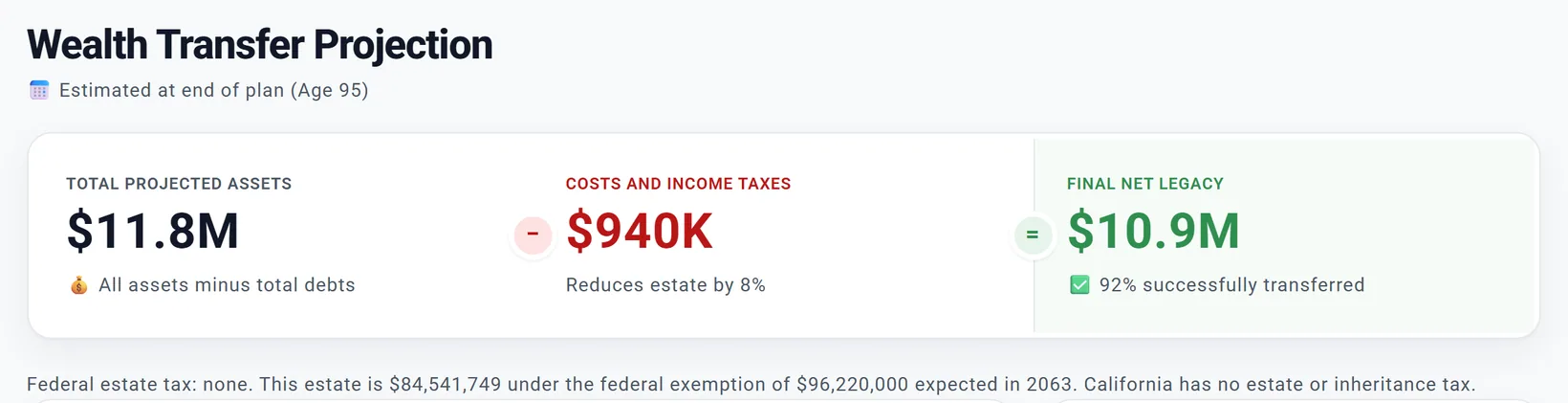
- One moment: the end of the plan, the Primary's Plan End (age 95 for Chris). If your spouse has a later Plan End of their own, it is the spouse's age instead, for example "(age 97 for Jamie)". The tab does not show a first death: for that, see After one of you dies.
- Future dollars: every figure is in the dollars of that year. The Today's / Future dollars switch does not change this tab.
- The Manual projection: one run of your plan with its set returns, never a Chance of Success average.
The starting figure, Total Projected Assets, is your plan's net worth in its last month (the same figure the Summary and the Net Worth chart reach): Chris and Jamie's $11,796,213 at 95.
How to open it
Choose Estate in the top bar, or in the menu on the left. The Plan completeness card on the Summary tab also links to it as an optional detail.

The three figures at the top
- Total Projected Assets: all you own at the end, less your debts.
- Costs and Income Taxes: the income tax on pre-tax money, capital gains tax if you turn step-up off, the cost of selling property and the cost of settling the estate. The line under it is that total as a share of the estate. With Charitable Giving set, it includes the gift and reads Costs, Income Taxes and Charity. When the estate owes federal estate tax, that tax is in the figure too and the label reads Costs and Taxes.
- Final Net Legacy: what your heirs receive, and that as a share of the estate.
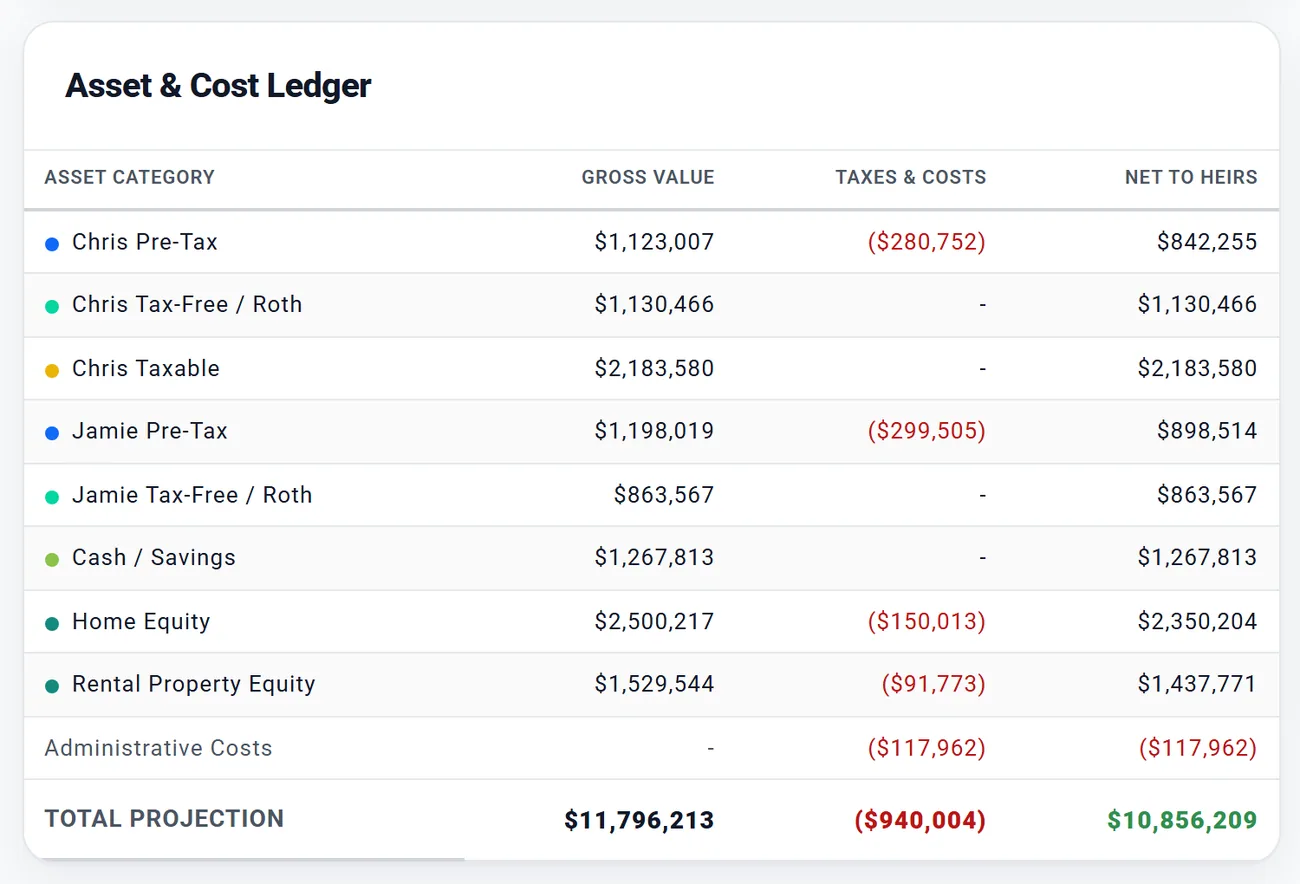
For Chris and Jamie: $11,796,213 less $940,004 (8%) leaves $10,856,209 (92%). The cards round them to $11.8M, $940K and $10.9M; the ledger below shows the exact figures.
Federal estate tax
On a US plan the tab estimates the federal estate tax: 40% of what the taxable estate is above the exemption in the year the plan ends. The exemption is $15,000,000 a person for a death in 2026 and $15,480,000 in 2027. For a later year the tab raises it with your plan's inflation, the same way it raises the tax brackets.
Most estates are under the exemption. The line under the three figures then reads "Federal estate tax: none", with how far under the estate is and the exemption expected in that year, and no figure on the tab changes.
When tax is owed:
- The ledger gets a Federal Estate Tax row, the middle figure includes it, and Key Takeaways shows the sum: the taxable estate, less the exemption, at 40%.
- The taxable estate is what you own less your debts, less Admin Costs and Charitable Giving. Anything marked as held outside your estate is left out (below).
- Income tax your heirs pay on pre-tax money is worked out after the estate tax that money bore, so the two taxes are not stacked. The law gives heirs an income tax deduction for it.
Couples
The tab shows the end of the plan, after both of you. At the first death it assumes everything passes to the survivor, so no federal estate tax is owed then, and the first spouse's unused exemption carries over to the survivor. When your plan has one of you living longer, the line under the figures names that first death and the amount carried over. The carried amount is the exemption of the year of the first death; it does not grow after that.
The Federal estate tax group
Below Scenario Parameters, the Federal estate tax group (titled Estate tax in a state with its own) shows the exemption the tab used. It rests closed on a plan far under the exemption; click its title to open it.
- Lifetime taxable gifts: gifts above the yearly gift exclusion ($19,000 a person in 2026), as reported on gift tax returns. They use up exemption. Most people leave this at 0. A couple has one for each of you.
- Unused exemption from a late spouse (a plan for one person): the amount a late spouse's estate tax return carried over to you.
- The carry-over switch (a couple's plan), described above.
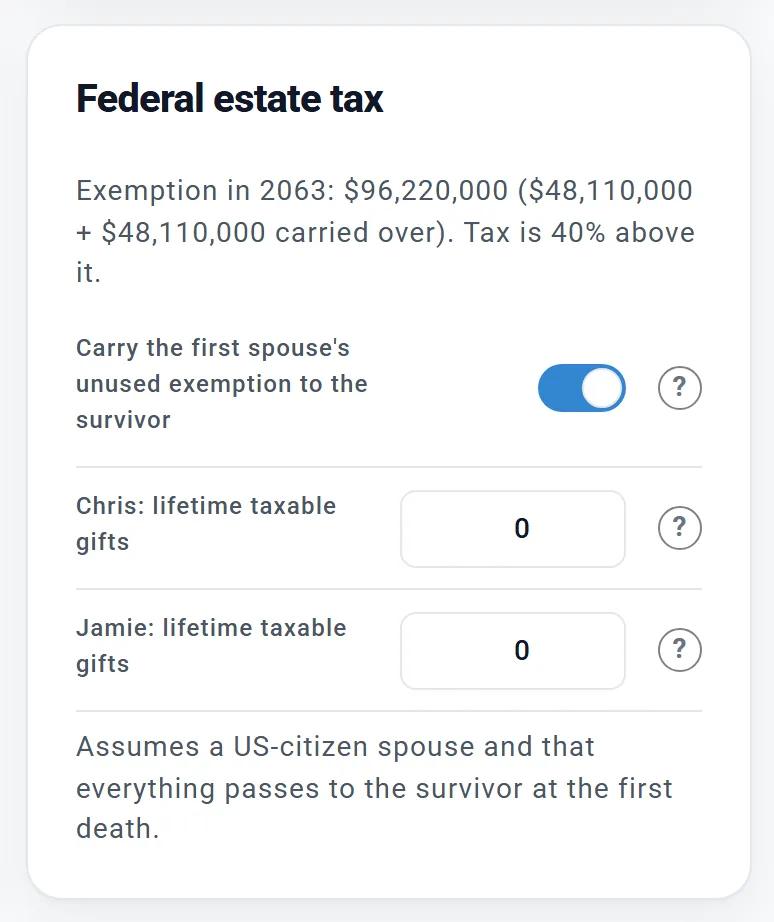
These are saved with the plan, like the rates. The estimate assumes a spouse who is a US citizen.
State estate tax
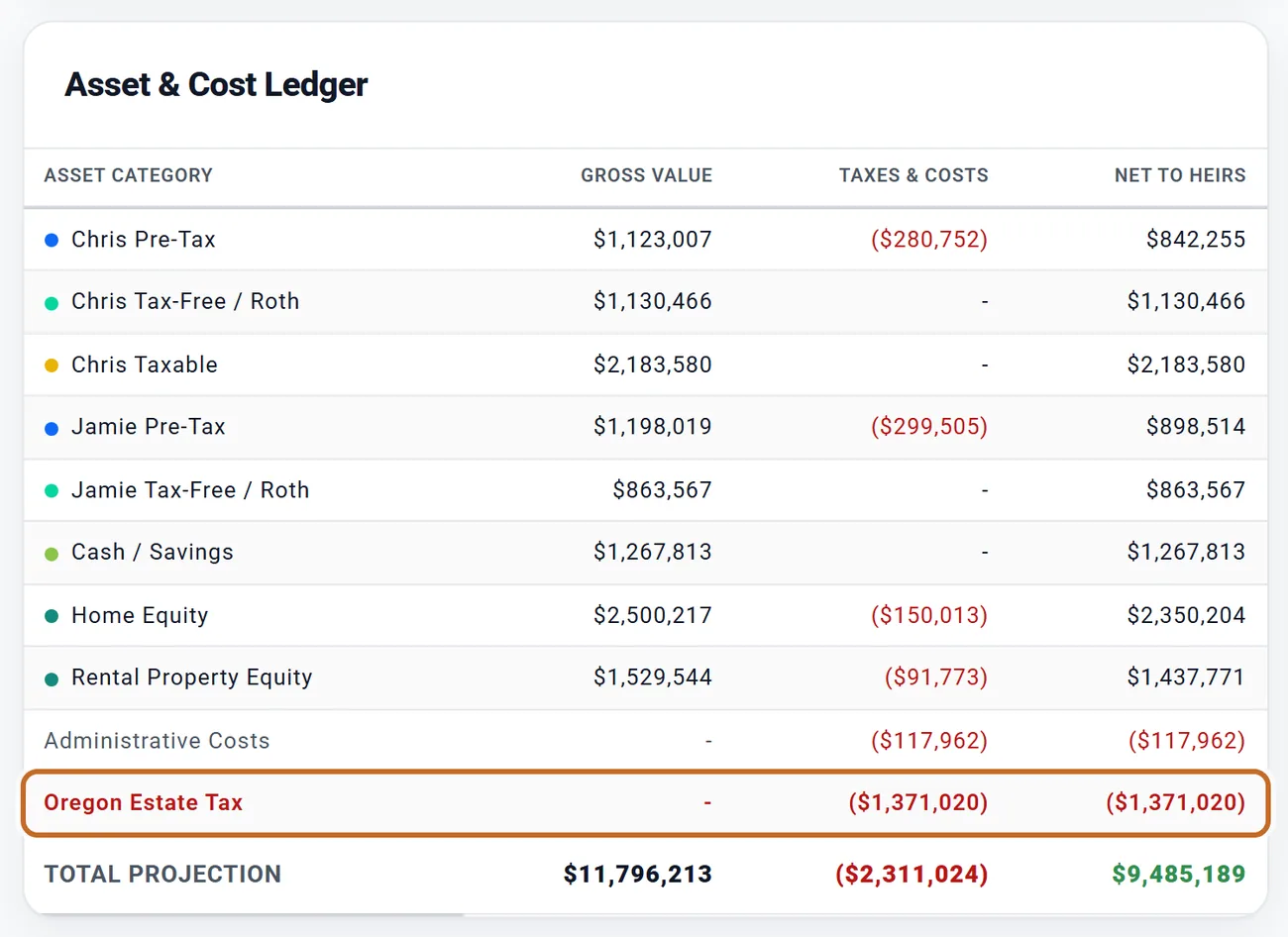
Twelve states and DC have an estate tax of their own: Connecticut, Hawaii, Illinois, Maine, Maryland, Massachusetts, Minnesota, New York, Oregon, Rhode Island, Vermont, Washington and the District of Columbia. When your plan's state (the Location row in your Profile) is one of them, the tab works it out by that state's own rules: a row such as Oregon Estate Tax in the ledger, in the middle figure, and in Key Takeaways. The line under the figures gives the tax, the taxable estate and the state's exemption, or says the estate is under it. In a state with no estate or inheritance tax, the line says so by name.
- They start far lower than the federal tax. Oregon's exemption is $1,000,000, Massachusetts' $2,000,000, Washington's and Minnesota's $3,000,000, against $15,000,000 for the federal tax.
- Many are fixed in state law. Oregon, Massachusetts, Washington, Minnesota, Illinois, Maryland, Vermont and Hawaii set a dollar figure that does not rise with inflation. The tab keeps that figure for the year your plan ends, while your estate is in that year's dollars, so the tax can look large on a long plan. The tab says so when it applies. New York, Maine, Rhode Island and DC raise theirs each year, and Connecticut uses the federal amount; the tab raises those with your plan's inflation.
- New York has a cliff. An estate more than 5% over New York's exemption is taxed on all of it, not only the part above. The tab says when that applies.
- The state tax comes off first. It is deducted before the federal estate tax is worked out.
- Heirs cannot deduct it. The income tax deduction described above is for federal estate tax only.
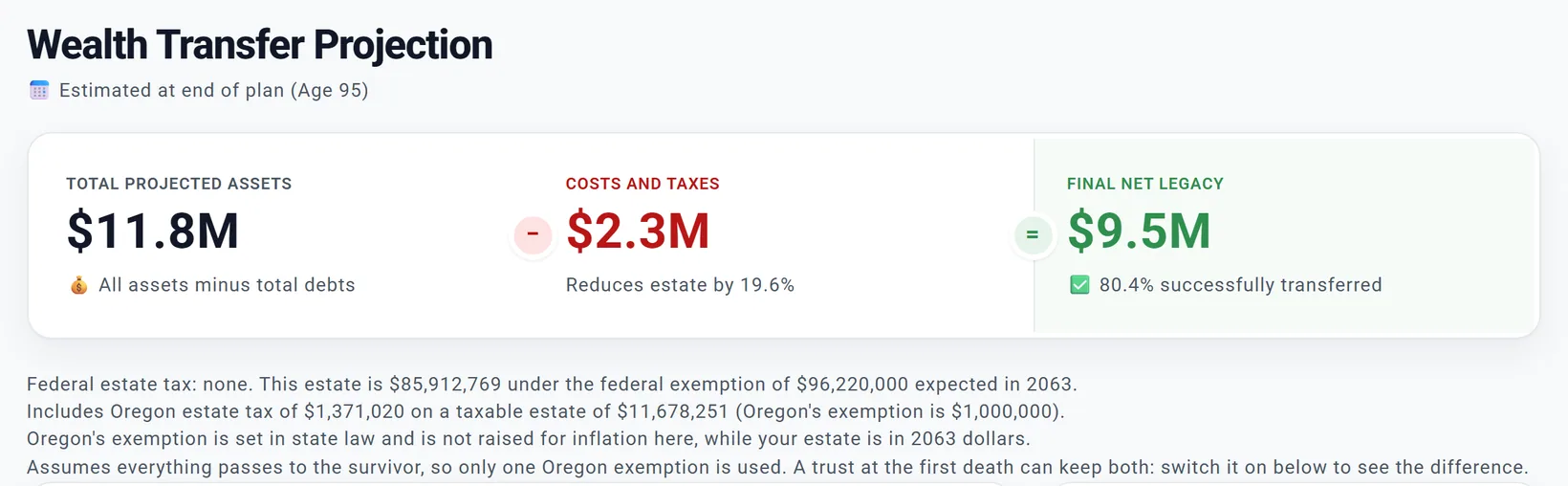
Chris and Jamie's plan is in California, which has no estate tax. Here is the same plan as if it were in Oregon: Oregon estate tax of $1,371,020 on a taxable estate of $11,678,251, which takes Final Net Legacy from $10,856,209 to $9,485,189. The middle figure reads Costs and Taxes, and the lines under the figures say that Oregon's exemption is fixed and that only one exemption is used.
Couples. Only Hawaii and Maryland carry the first spouse's unused exemption over to the survivor. In the other eleven, when everything passes to the survivor, the first spouse's state exemption is lost, and the tab shows that. A trust set up in the first spouse's will can keep it: in the Estate tax group, switch on the line that begins "A trust at the first death kept the first spouse's" to see the estate with both. An Oregon couple with $2,000,000 owes $101,250 with one exemption and nothing with two.
The estimate takes all your property as being in your plan's state, and does not include gifts made in the last years before a death, which some states add back.
State inheritance tax
Five states tax the person who inherits, by their relationship to you: Kentucky, Maryland, Nebraska, New Jersey and Pennsylvania (Maryland has an estate tax too). When your plan's state is one of them, the tab works out what each heir owes on what they receive and shows the total as a row such as Pennsylvania Inheritance Tax, in the middle figure and in Key Takeaways.
- Who inherits comes from your beneficiaries. Each person's relationship (Child, Sibling, Niece/Nephew, Friend and so on) sets their rate. An organization never pays it. With no beneficiaries set up, the tab takes your children to inherit everything and says so.
- Children: nothing in Kentucky, Maryland and New Jersey; 1% of what each child receives above $100,000 in Nebraska; 4.5% of everything in Pennsylvania.
- Brothers and sisters: nothing in Kentucky and Maryland; 1% above $100,000 in Nebraska; 12% in Pennsylvania; 11% to 16% above $25,000 in New Jersey.
- Nieces and nephews: nothing in Kentucky (since 2026); 10% in Maryland; 11% above $40,000 in Nebraska; 15% in Pennsylvania; 15% to 16% in New Jersey.
- Friends and others pay the most: 6% to 16% in Kentucky, 10% in Maryland, 15% above $25,000 in Nebraska, 15% in Pennsylvania, 15% to 16% in New Jersey.
- A spouse pays nothing in any of them.
- Life insurance is not taxed.
- Maryland credits its inheritance tax against its estate tax, so the two are not both charged in full.
The Beneficiary Allocation table shows each person's amount after their own inheritance tax, with the tax under it. The estimate takes every heir as an adult (Nebraska exempts heirs under 22), does not take the discount for paying early (5% in Pennsylvania within three months, and in Kentucky within nine), and gives each heir the same share of every account.
Held outside my estate
To see your estate with something left out of it, for example money you have put in an irrevocable trust, open the item on the Accounts tab and tick Held in an irrevocable trust or otherwise outside my estate. The box is on a taxable investment account, a home, a rental property and the items under Other Assets.
- The item is listed in the ledger with "outside the estate", left out of every total and out of the estate tax, and added back in a "Plus ... held outside the estate" line under Final Net Legacy.
- It gets no step-up: the tab takes the Capital Gains Rate off its gain even with Step-up Basis on.
- Nothing else in your plan changes. The plan still spends and taxes that money as yours. This is a what-if for the estate figures, not a model of a trust.
The box is not offered on retirement accounts, an HSA or cash accounts. A life insurance policy has its own Owned by choice for a trust.
The Optimizer counts it too
When your estate owes federal estate tax, the Optimizer, the AFTER-TAX ESTATE figure on Roth & tax moves, Compare Plans and Find the best option take off the estate tax your savings cause, and their cards add "and after the federal estate tax on it". Above the exemption this usually does not change which Roth conversion plan comes out ahead. It makes the gap between two plans about 40% smaller, and every after-tax estate figure lower.
A state estate tax is counted the same way, and it does change the comparison. Income tax you pay on a Roth conversion leaves your estate, so the state does not tax that money again, while heirs get no deduction for state estate tax on pre-tax money they inherit. In these states a conversion comes out a little further ahead than it would elsewhere, by about the conversion's tax rate times the state's rate.
The flow chart
Wealth Distribution Flow follows the money from left to right: the Gross Estate, then each kind of asset (Tax-Deferred, Tax-Free / Roth, Taxable, Cash, Real Assets, and Other Assets or Life Insurance when you have them), then where each goes: To Heirs, or a cost such as Income Tax, Liquidation, Admin Costs or Charitable Giving.
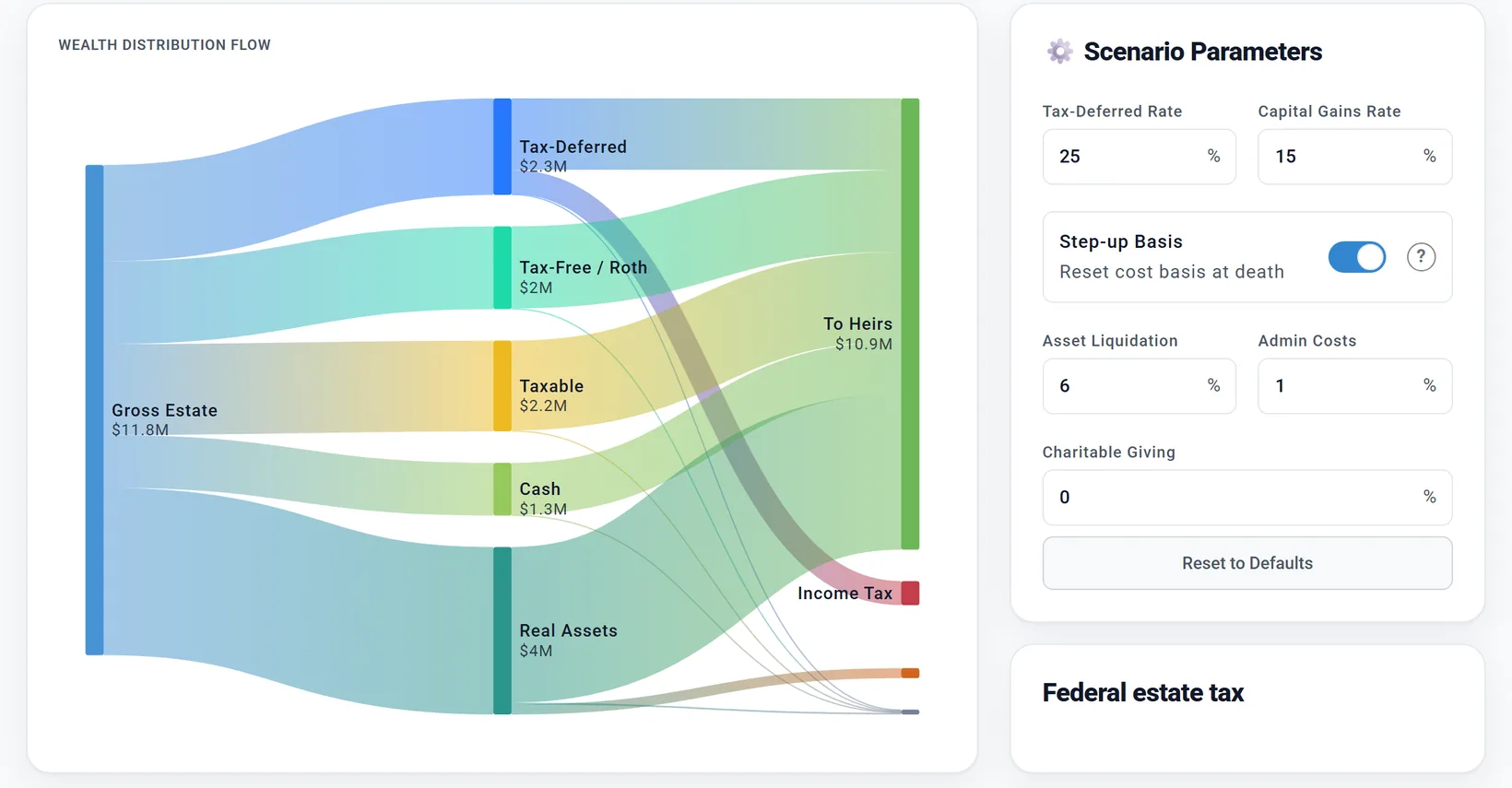
- A band too thin to label has no name on the chart: rest the mouse on it to see what it is and how much.
- Once you set up beneficiaries, To Heirs is split into one band for each of them (see Beneficiaries).
The Asset & Cost Ledger
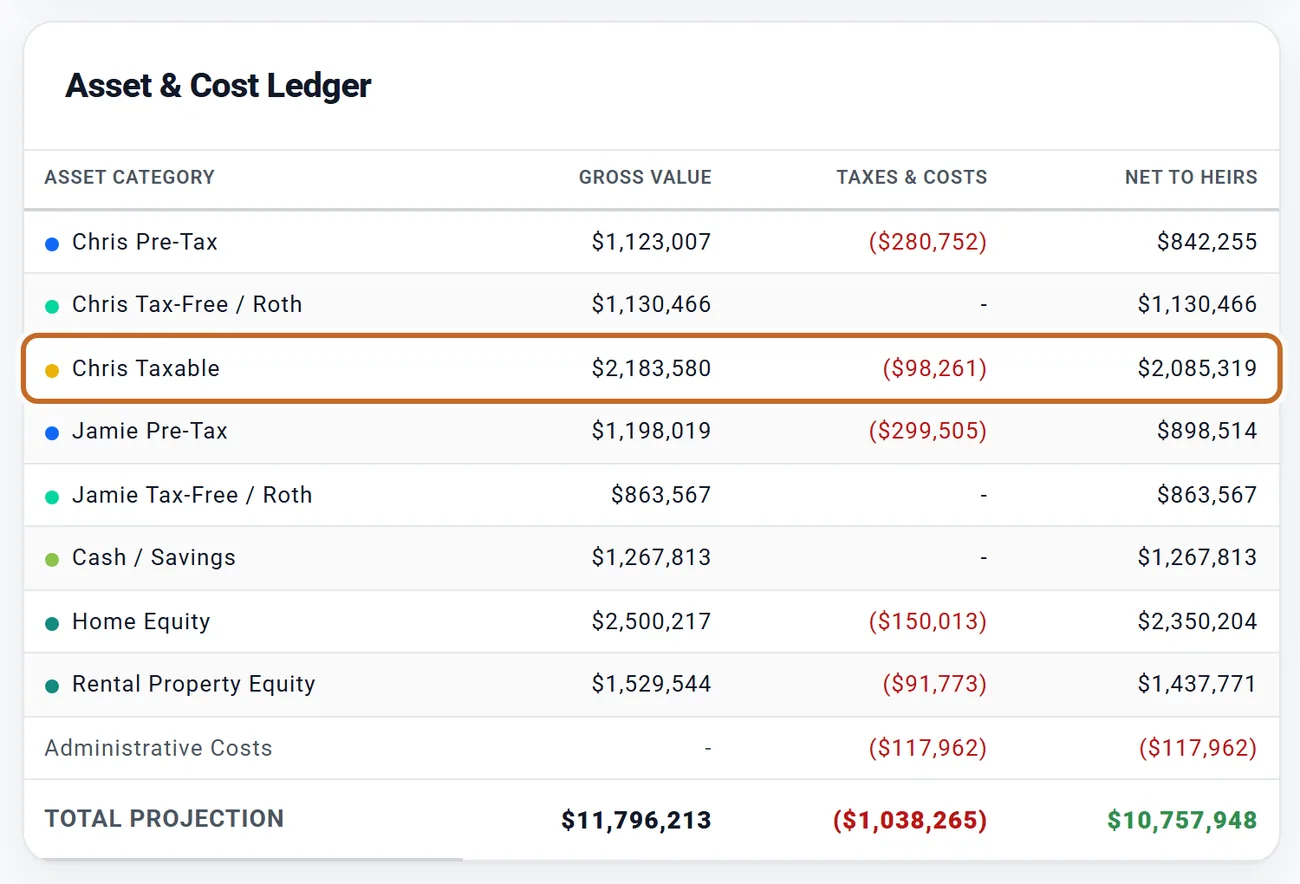
The Asset & Cost Ledger lists each part of the estate with its Gross Value, its Taxes & Costs and what is left, Net to Heirs. Total Projection at the bottom adds them up.
- Investment accounts are one row per person and kind, such as "Chris Pre-Tax" or "Jamie Tax-Free / Roth", not one row per account. An HSA has its own row, and an inherited IRA you still hold shows as "Chris Inherited Pre-Tax" or "Chris Inherited Roth".
- Home Equity and Rental Property Equity are the values less the mortgages linked to them. A loan that is not linked to a property, such as a car loan, is its own negative row.
- Administrative Costs is a row of its own.
- Rest the mouse on an amount in Taxes & Costs to see what it is made of, for example "Income Tax: $280,752".
What each kind of asset costs your heirs
| Asset | What the tab takes off | Chris and Jamie at 95 |
|---|---|---|
| Pre-tax money: IRAs, 401(k)s, inherited IRAs, an HSA, deferred compensation not yet paid | Income tax at the Tax-Deferred Rate (25%) on the whole balance. Your heirs pay income tax as they take it out. | $1,123,007 x 25% = $280,752 for Chris, $299,505 for Jamie |
| Roth accounts and cash | Nothing. | $1,994,033 of Roth, $1,267,813 of cash, in full |
| Taxable accounts (brokerage) | Nothing while Step-up Basis is on. Off: the Capital Gains Rate on the part that is gains. | $0 (off: $98,261) |
| Home and rental equity, other assets | Asset Liquidation (6%), the cost of selling them. | $150,013 on the home, $91,773 on the rental |
| The whole estate | Admin Costs (1%), settling the estate. | $117,962 |
| Life insurance still in force | Nothing: the death benefit counts in full. A policy owned by a trust is listed with "outside the estate" and left out of every total. | None in this plan |
- The tab applies one rate to all your pre-tax money at the end. It does not spread your heirs' tax over the ten years most heirs have to empty an inherited IRA, or use their own tax brackets: set the Tax-Deferred Rate to the rate you expect them to pay.
- An HSA counts as pre-tax because an heir who is not your spouse pays income tax on all of it.
- With step-up off, the gains are the share set as Taxable Gains (%) in the Taxes box (30% to start with): $2,183,580 x 30% x 15% = $98,261.
For what happens to an IRA you inherit yourself, see An inherited IRA on the accounts page.
Scenario Parameters
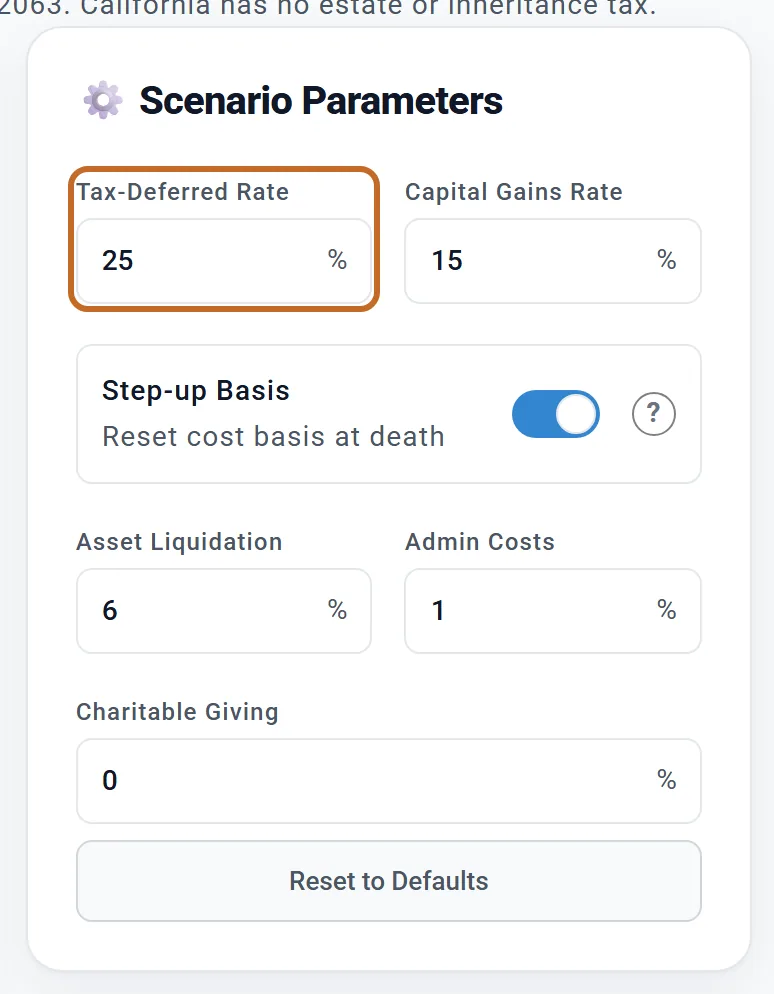
The Scenario Parameters panel holds the rates the tab uses. Type a whole percent; the tab redraws at once.
- Tax-Deferred Rate (25%): the income tax your heirs pay on pre-tax money.
- Capital Gains Rate (15%): used only with step-up off.
- Step-up Basis (on): "Reset cost basis at death". The "?" beside it explains it (below).
- Asset Liquidation (6%) and Admin Costs (1%).
- Charitable Giving (0%): see Leaving part to charity.
- Reset to Defaults puts every rate back.
These rates are saved with the plan you have open, so each plan can have its own. They change no other part of the projection.
The Tax-Deferred Rate counts in the Optimizer too
On the Withdrawals tab, the Optimizer, the AFTER-TAX ESTATE figure on Roth & tax moves and Find the best option on Withdrawal order all value pre-tax money left at the end after this same rate, and their cards name it: "pre-tax money counted after an estimated 25% tax, your Estate tab assumption". Set it to 32% here and they count it at 32%. On the Estate tab itself, 32% takes Chris and Jamie's legacy from $10,856,209 to $10,693,737. See what the Optimizer looks for and what a Roth strategy is worth.
Step-up Basis
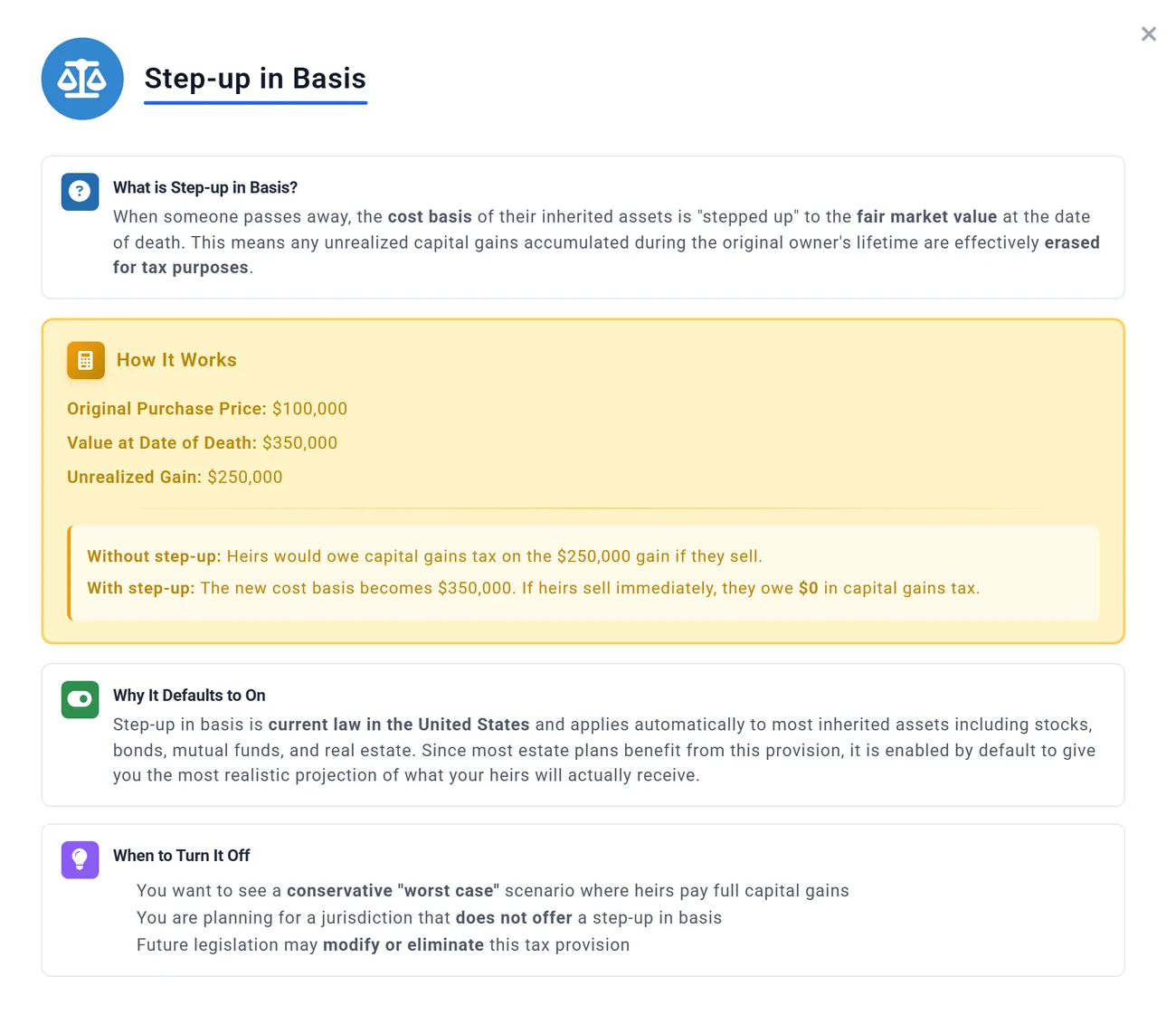
Under US law, what your heirs inherit takes its value on the day of death as its cost, so the gains it built up while you owned it are not taxed. That is why the switch starts on, and taxable accounts lose nothing.
Turn it off to see a cautious case where your heirs pay capital gains tax as well: Chris's taxable row then loses $98,261, and the tab's costs rise from $940,004 to $1,038,265.
Leaving part to charity
Charitable Giving sets a share of the estate that goes to charity. The tab takes it from pre-tax money first (then taxable accounts, property, cash, and Roth money last), because pre-tax money is what your heirs would pay income tax on. So the gift also cuts the income tax.
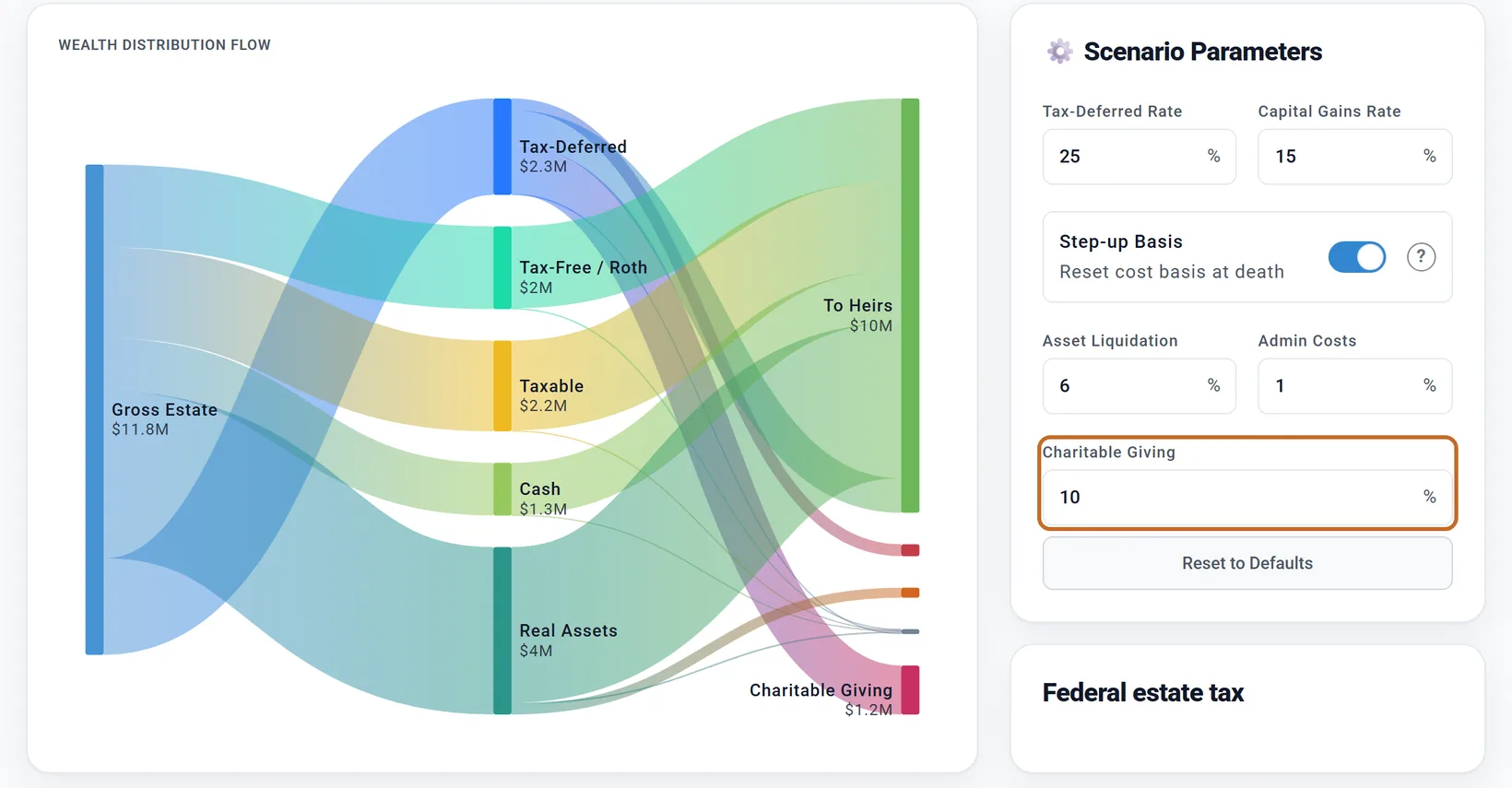
For Chris and Jamie, 10% sends $1,179,621 to charity, all of it from their pre-tax accounts; the income tax drops from $580,257 to $285,351 and Final Net Legacy is $9,971,493. With a gift the middle figure at the top becomes Costs, Income Taxes and Charity, and the gift also shows in the ledger's Taxes & Costs column and in the flow chart.
Key Takeaways
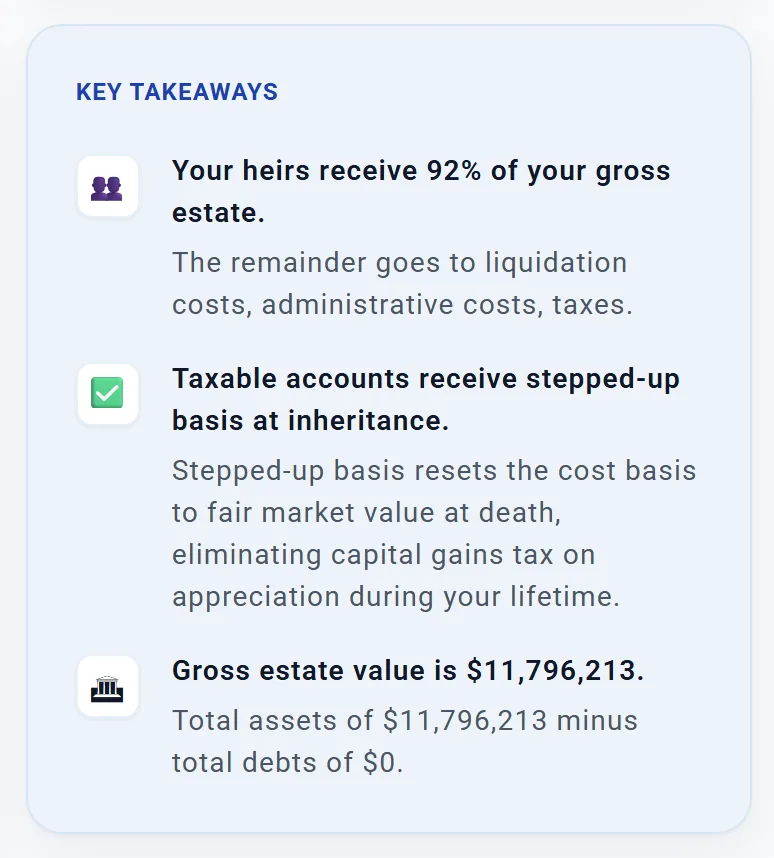
Key Takeaways, beside the ledger, sums up three points in words: the share your heirs receive and what the rest goes to, whether step-up applies, and the size of the estate.
Beneficiaries
At the bottom of the tab you can list who receives the estate and in what shares. The tab then splits Final Net Legacy between them. When the list includes an organization, you also choose how the shares are filled.
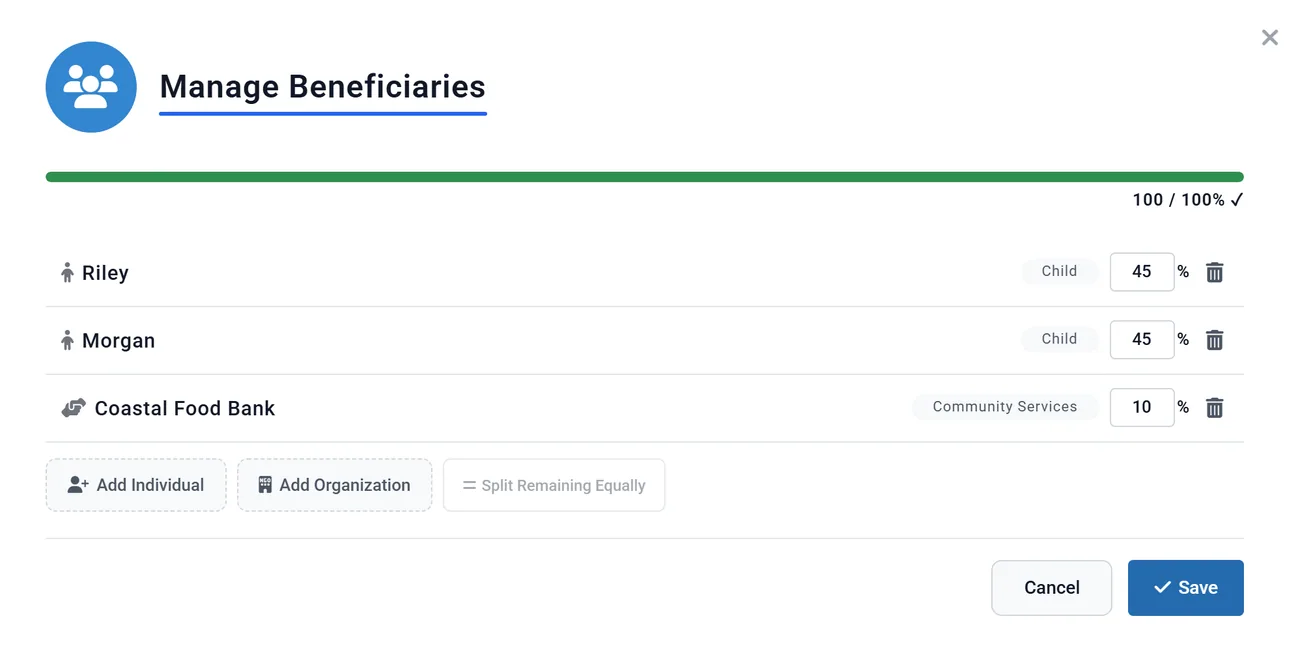
- Choose Set Up Beneficiaries (Manage Beneficiaries once you have some).
- Choose Add Individual (a name, the relationship and a percent) or Add Organization (a name, a category such as Community Services, and a percent), then Add. Repeat for each, up to 15.
- Split Remaining Equally shares out what is not yet given.
- Choose Save. It closes only when the shares add up to exactly 100%.
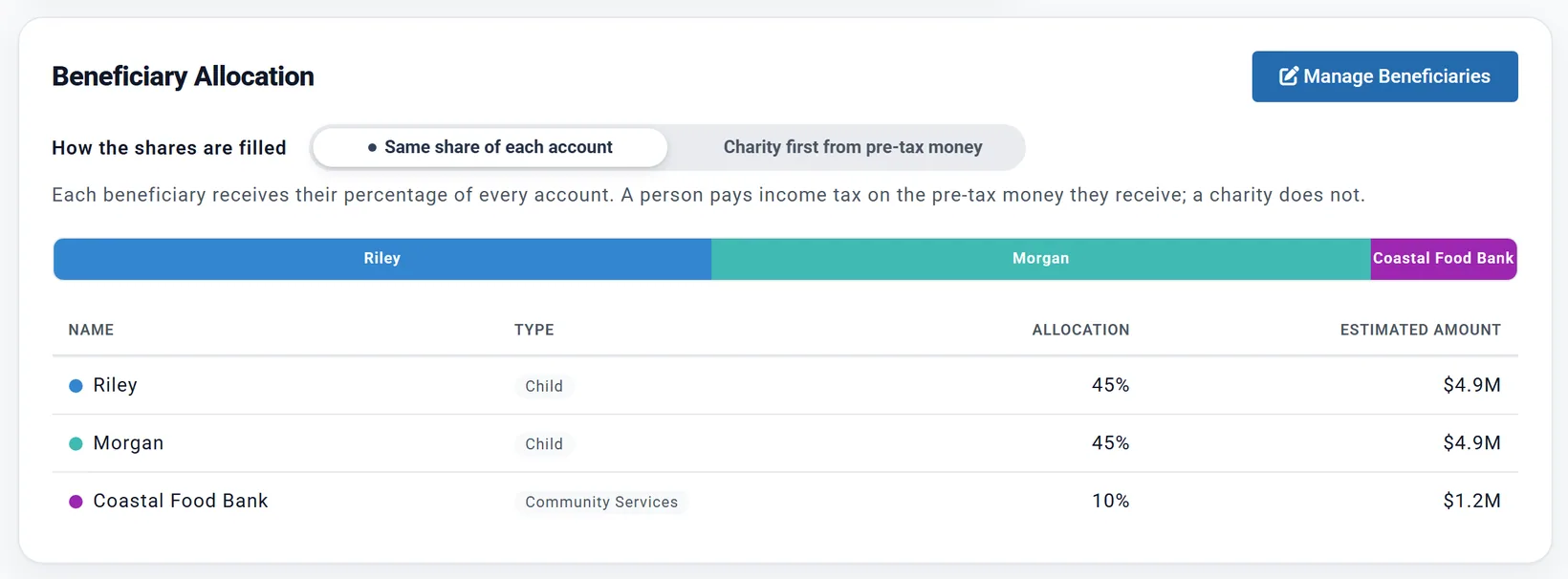
- Estimated Amount is what each one receives. A person's amount is after the income tax they pay on the pre-tax money they receive.
- An organization in this list pays no income tax on what it receives, and its part counts as left to charity for the federal and state estate taxes. So listing one lowers the costs at the top: for Chris and Jamie, Coastal Food Bank at 10% takes Costs and Income Taxes from $940K to $857.8K.
- Charitable Giving in Scenario Parameters is a separate gift that comes off first, before the list shares what is left.
- The flow chart ends in one band for each beneficiary instead of To Heirs.
How the shares are filled
When the list includes an organization, How the shares are filled appears above the bar. It has two choices:
- Same share of each account (where it starts): each beneficiary receives their percentage of every account, after the estate's own costs (settling the estate and any estate tax). People then pay income tax on the pre-tax money they receive; an organization does not.
- Charity first from pre-tax money: organizations receive pre-tax money first, because a charity pays no income tax on it. If they need more, it comes next from taxable accounts, then property, cash, and Roth money last (the same order as Charitable Giving). Each share is then its percentage of what everyone receives after tax, so two people with the same percentage receive the same amount after the income tax they owe.
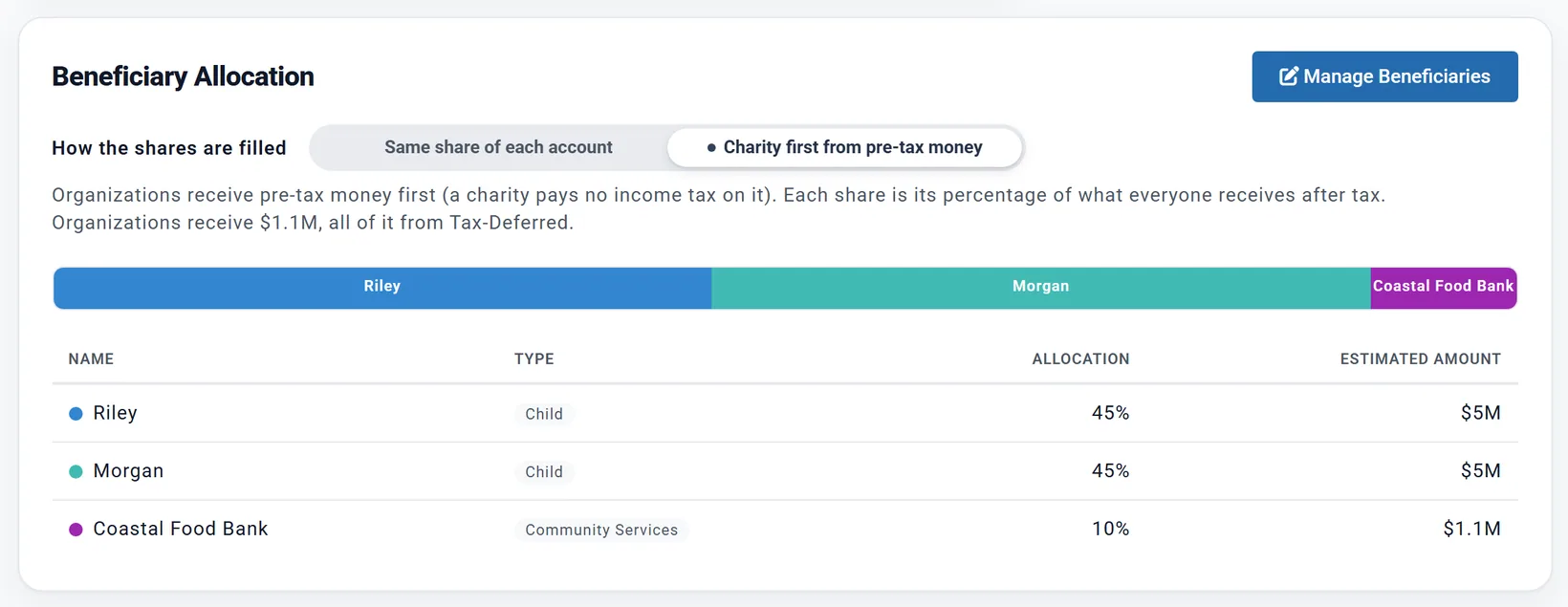
For Chris and Jamie, charity first sends Coastal Food Bank's $1.1M all from their pre-tax accounts. Costs and Income Taxes at the top fall from $857.8K to $661.6K, and Riley and Morgan each receive $5M instead of $4.9M. The flow chart shows where each share comes from.
- The choice is saved with the plan, so two plans can differ. Reset to Defaults leaves it as it is.
- With Charitable Giving set as well, that gift comes off first, and the list shares what is left.
- It is not offered on UK or Canadian plans, where the tab prices gifts to charity through the inheritance tax or the final return.
What the Estate tab does not model
- For a state inheritance tax: heirs under 22 (Nebraska), discounts for paying early, and which account goes to which heir.
- For a state estate tax: property in another state, a move to another state before the plan ends, and gifts in the last years before a death.
- For the federal estate tax: a spouse who is not a US citizen, leaving part of the first estate to someone other than your spouse, and gift tax you have already paid.
- Your heirs' own tax brackets, and the years they take to empty an inherited IRA: one rate at the end instead.
- Probate and lawyers' fees beyond the Admin Costs rate.
- What passes at the first death: the tab shows the end of the plan, after both of you.
- Trusts, beyond marking an item as held outside your estate, and who inherits which account: beneficiaries share the whole legacy.
- A Chance of Success range: the tab uses one projection.
The tab is an estimate. For a real estate plan, work with an estate planning attorney or a tax professional.
Canada and the UK
- Canada: the tab prices the death-year tax as one final return with Canada's own rules, and has no step-up switch. See At a death, and the Estate tab. Canada
- UK: the US rate inputs are hidden and a UK Inheritance Tax panel works out inheritance tax. See Inheritance tax on the Estate tab. UK
- Other countries start from the US rates and step-up, with a note to set them to how your country taxes an estate.
On a Preview account
The whole tab is blurred under "Unlock Your Full Retirement Plan". Planner+